Blogging issues related to my GE 6 class, and the essay prompts was a great way for me to generate ideas and organize my thoughts. It definitely helped me become more coherent in conveying my thoughts into words as I penned them down straight from my head. At times, they would not make sense initially, but after seeing them in print, I could reread and organize them.
This was really different from class discussion, where we had to articulate our thoughts. Personally, I find it much easier to write out my thoughts in words as compared to talking about them. Thus, blogging really helped me with my thought process. As compared to essay writing, blogging felt much less formal and I could write my own personal opinions instead of being objective with evidences to support my opinions. My thoughts were not restricted as much as a result, and writing was much easier and more enjoyable.
Sunday, April 29, 2012

Adapting Authority


It is only because of such a value that nations can be united, progressing together as one big entity instead of individuals doing things purely for short term personal gains. China would not have been united if not for the authority of the warlords fighting each other and trying to consolidate land. Singapore would not have achieved such rapid growth from a third world country without any natural resources to a first world urban utopia, without the strict policies of the People's Action Party.

Democracy has however eroded the respect for and importance of authority, for it preaches equality of every man, arguing against complete autocracy. These days, ideas such as human rights and equality are of the utmost importance. Thus, to improve the use of authority, I feel that we should adapt authority to one, not of complete decision-making disregarding the people's voices, but one which decides the best course of action after hearing the mass's thoughts. The people on the other hand should also see authority as not chains which are controlling them, but leaders who are rallying their communities to achieve far greater results collectively.
Tuesday, April 17, 2012
Rebellion: The Power of Change

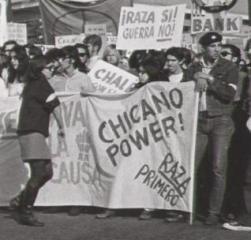

In most civilizations, major changes in ideology, culture and institutional structures are resulted due to the power of mass movement. When a large group of people feel oppressed or wrongfully treated, be it through the prevalent culture or law, discontent builds up. It builds up to the point that it cannot be tolerated any longer, and this is when it materializes in the form of a rebellion.

Rebellions have been around for as long as civilization itself. In the U.S. context, one example would be the Chicano Movement in the 1960s. Mexican-American students, unhappy with the substandard quality of education they get - poor equipments and materials, inadequate facilities, low expectations -, decided to execute this rebellion to ask for their rights. They staged walkouts out of the schools in Los Angeles, demanding these rights, knowing low attendance in the schools will affect their funding.

This cultural "value" of rebelling when groups of people are suppressed, no doubt changed the American cultural and social landscape. Because of movements like the Chicano movement and Watts protests, there was an increased awareness of the racial inequalities present in California, and the rest of United States. Only because of such movements did these inequalities get addressed.
Monday, April 16, 2012
Woody Guthrie


I learned of Woody's upbringing, from Oklahoma to his travels to and fro Los Angeles, and how these experiences had shaped his perception of race. He arrived in Los Angeles in 1937 like many other immigrants, flooding the city's population with outside influences. There, he was raised in a culture of white supremacy, and thus was a part of the racial hate.

He changed his mind later though, to one of racial acceptance, performing protest songs on the KFVD Radio Station in California. Hearing the songs he sang and the drawings he did, it was moving. He created these masterpieces about the current issues which he felt strongly for. One example would be his drawing Amarillo Dust Clouds, which portrayed the dust storms during the 1930s, which severely affected the agriculture in America, and thus the livelihood of many.

At the event, I found out the extent of Woody's work and his influence, for most of the audience were loyal fans of his. They knew the words to his song, felt great passion in the speeches panelists made about their beloved idol, and appreciated his work while he was around. Now, I can safely say that I feel the same appreciation as them too.
Monday, April 9, 2012
Social Issues Speaker Series: Maria Valera

Maria Valera became a community organizer in 1962, when she joined the Student Non Violent Coordinating Committee, and had been one ever since. Not satisfied with the literacy materials of the time, she was a pioneer in using alternative media such as photos to train community leaders and teach literacy.
In 1967, she moved to New Mexico to organize rural communities there and the Southwest to create sustainable enterprises to achieve "economical and cultural self-determination." For her excellent work there, she won a MacArthur Fellowship.

In the Social Issues Speaker Series, she talked about the differences between the Silent Generation of the 1960s, and the Millennium Generation of present. Both generations had much similarities in terms of creating movements and making the changes they felt were necessary. However, there were also many differences.
The Silent Generation was the one which brought about huge movements such as the Chicano Movement, which asked for equal rights towards Mexican-Americans. They were apathetic about the economic future, and more concerned with human rights.
The Millennium Generation also brought about mass movements of change such as the Occupy, and the Arab Spring movement. However, unlike the Silent Generation, they used a lot of mass media and networking tools (e.g. Facebook, twitter) to mobilize their movements. Unlike the Silent Generation which placed much emphasis on organization - gathering and rallying people to the cause in a sweeping movement-, the Millennium Generation focused on mobilization, which was empowering individuals to start mass movements wherever they were, by themselves. Only because of advancements in technology has this become possible.

"Whenever there is oppression, there is resistance."
Maria believed that people cannot be controlled and dictated to follow rules they do not agree with, or it will ultimately lead to them rebelling to ask for their rights. It is imperative that governing bodies address these issues once their existence is realized, for if they are ignored, they will only materialize in damaging forms, such as riots, rebellions and even war.
Wednesday, April 4, 2012
Effects of the Recession on the American Dream


Starting form the subprime mortgage crisis, America has spun into a recession with bad debts and now a suffering economy with high unemployment rates. This disaster indubitably made many question the American Dream. Is it even still alive? Should one no longer have the expectations of what the American Dream offers anymore?

"If you're willing to put in the work, the idea is that you should be able to raise a family and own a home; not go bankrupt because you got sick, because you've got some health insurance that helps you deal with those difficult times; that you can send your kids to college; that you can put some money away for retirement," was a part of President Barrack Obama's speech.
Many a times have we heard of success stories where one persistently refuses to give up, in spite of countless rejections and impediments he or she faces. This recession is just one of those obstacles we have to overcome, and if we are willing to work hard and stop at nothing to achieve what we really desire - a comfortable life - I am certain we can achieve it. The American Dream is still alive in us.
Monday, March 26, 2012
The Ideals of the American Dream
The American Dream itself is an ideal scenario of the cultural, economic and political environments. According to the American Dream, one should be able to embrace whichever culture he wants. He should have the freedom to choose the religion and culture he wants to subscribe to.

The economic aspect of the American Dream on the other hand is that one is financially capable with a stable job, without having to worry about his livelihood in the future. It is the complete opposite of what was portrayed by Kit Kittredge's family's plight in the show Kit Kittredge, where her father loses his job and plunges into poverty during the Great Depression.

Politically, I feel that the American Dream is one where anyone has the freedom to express his or her opinions freely, and has a say in who governs the country. This is definitely present in the United States, for the people have a high degree of freedom of speech, and elections are held every four years, with literally anyone being able to run for the office.

I think that these three aspects of the American Dream can be achieved together. Political and cultural freedom both advocate the acceptance of others who have differing opinions as compared to our own, and might even go hand in hand. These two factors are already considerably present in our society today, for most people do have the right to choose their religions, cultures and even political affiliations. The economic aspect of the American Dream, which is financial stability however is harder to attain, for there would always be people who are of lower income, or even unemployed. However, it is still possible for all Americans to have an American Dream, for everyone has their own version - their own expectations - of the dream. It is the government's role to ensure that all or at least the majority of these Dreams are met, or made easier to achieve.
Subscribe to:
Posts (Atom)